Mesh Routing and Forwarding
This page documents how a Rembus Mesh Network keeps every broker's routing tables consistent, and how Pub/Sub and RPC messages are actually forwarded between brokers once those tables are populated. The logic described here is mostly implemented in src/admin.jl, with the data-plane counterpart (actual message delivery) in src/broker.jl and src/twin.jl.
Routing state
Each Router keeps the following tables (see src/types.jl):
topic_impls::Dict{topic => Set{twin}}: which connected twins expose an RPC method namedtopic.topic_interests::Dict{topic => Set{twin}}: which connected twins are subscribed totopic(or to a glob pattern).topic_auth::Dict{topic => Dict{rid => true}}: the set of components authorized to use a private topic.glob_topics: the subset oftopic_interestskeys that are "match everything" patterns (**,/**/), kept separate so that broadcasting a message does not need to evaluate a regex per subscriber.id_twin::Dict{rid => twin}: every named twin currently connected to this router, i.e. its direct neighbors (downstream components/brokers and the upstream broker it connects to, if any).eid::UInt64: an ephemeral id generated for this router instance, used to stamp messages as they travel through the mesh (see below).
Because a broker is always also a component (component(url, ws=port)), the twin that represents the upstream connection is stored in id_twin and topic_impls/topic_interests exactly like any other twin: from the point of view of a router, there is no structural difference between "a local client" and "another broker in the mesh". This is what allows the same tables and the same forwarding code to work regardless of how many hops away the real producer/consumer of a message is.
Bootstrapping a link: SETUP_CMD
When a component connects to a broker (and, symmetrically, when a broker connects upstream), it sends a setup AdminReqMsg built by twin_setup/twin_configuration (src/helpers.jl) that lists the topics it already exposes/subscribes to:
Dict("exposers" => [...], "subscribers" => [...], COMMAND => SETUP_CMD)admin_command handles SETUP_CMD in src/admin.jl by registering the twin in topic_interests/topic_impls for each announced topic and replying with EnableReactiveMsg. This seeds the router's tables with the state the peer already had before the link existed, so reconnects and newly-joined mesh nodes immediately become reachable without replaying history.
Propagating changes: subscribe/expose commands
After the initial setup, every subsequent subscribe/expose/ unsubscribe/unexpose admin command issued by a client must be propagated to every other broker in the mesh, not just applied locally, so that a publisher connected to broker A can reach a subscriber connected to broker C through broker B. This is done by admin_command for SUBSCRIBE_CMD, EXPOSE_CMD, UNSUBSCRIBE_CMD and UNEXPOSE_CMD:
- Check authorization (
isauthorized) for private topics. - Call
mark_and_broadcast(router, twin, msg), which both floods the command to this router's neighbors and returns whether the local table update should actually happen (see loop prevention below). - Only if step 2 returns
true, updaterouter.topic_interests/router.topic_implsfor the local twin.
Loop prevention with rmark and touch
A mesh is a general graph of brokers, so a naive flood would broadcast forever on any cycle. Two cooperating markers, both carried inside msg.data, prevent this:
rmark(route mark): the list of routereids that have already processed this command.mark_and_broadcastchecks whetherrouter.eidis already inmsg.data["rmark"]; if so the command has already looped back to this router and is dropped (returnsfalse, so the table is not touched twice and the flood stops). Otherwise the router appends its owneidand proceeds to broadcast.touch(visited twins): the list of component ids (rid) that have already received this message.admin_broadcastiterates over every named, open twin connected to this router (router.id_twin) and skips: the twin that is the origin of the command (rid(tw) != rid(twin)), and any twin whose id is already intouch. For every twin it does send to,color_adminappends that twin'sridtotouchbefore callingtransport_send, so the next broker down the line knows not to bounce the command straight back.
Together, rmark stops re-processing at the router level (idempotency of the state change) while touch stops redundant retransmission at the link level (every edge of the mesh carries the command at most once in each direction). The combination means a command issued by any component eventually reaches every broker/component in the mesh exactly once, no matter the topology (tree, ring, or arbitrary graph).
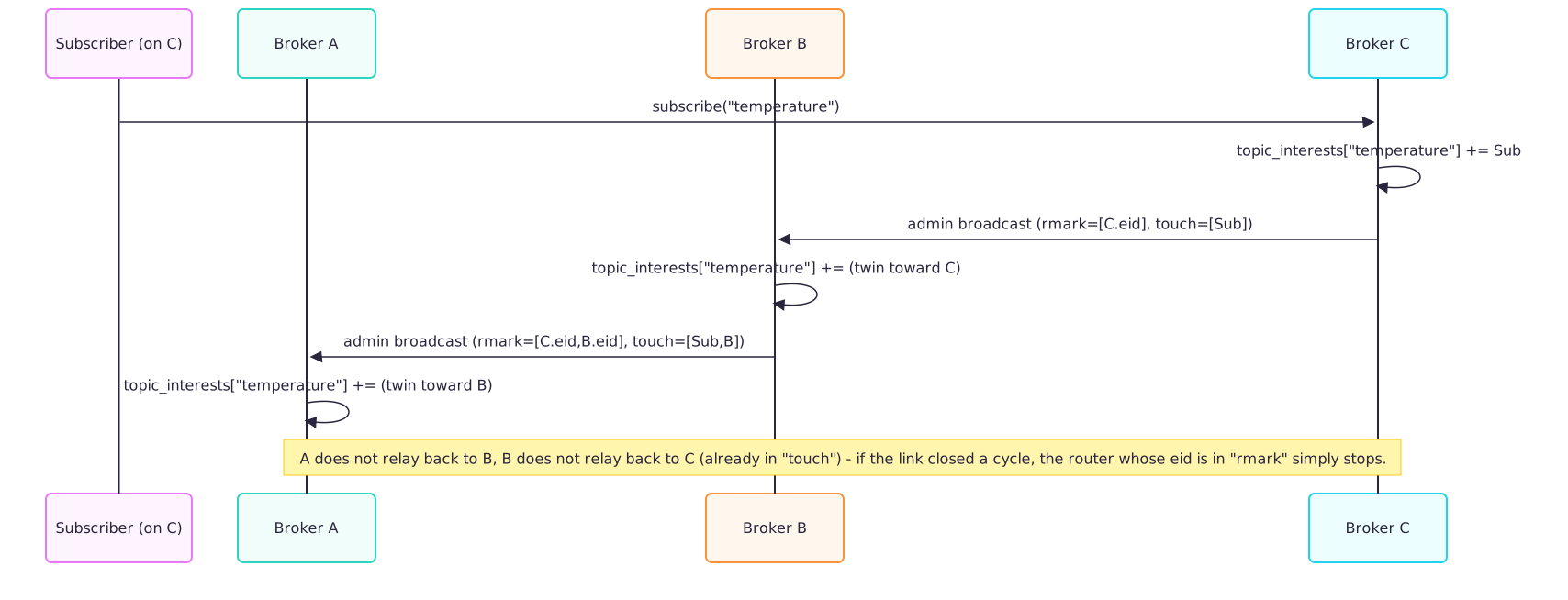
After this propagation, every broker on the path from A to C has a topic_interests["temperature"] entry pointing towards the neighbor that is closer to the real subscriber, which is exactly what the data plane needs (next section).
ismultipath(router) gates whether a router bothers to track routes at all; it currently always returns true; a hook for a future optimization that would only apply to real brokers rather than plain request/response pools.
admin_broadcast and the future/response path
admin_broadcast also resolves the original command's future if the issuing twin registered one for msg.id (twin.socket.direct), so the client that issued the subscribe/expose command gets its STS_SUCCESS response immediately, independent of how far the flood still has to travel.
Data-plane forwarding (Pub/Sub)
Once topic_interests is populated mesh-wide, publishing a message (pubsub_msg in src/twin.jl) does two things on every broker it passes through:
local_subscribers(router, twin, msg): invokes any locally-registered Julia callback bound to the topic (exact match or glob pattern).broadcast_msg(router, msg)(src/broker.jl): computes the set of authorized twins interested inmsg.topic— the union oftopic_interests[topic]and every twin subscribed through aglob_topicspattern, filtered bytopic_authfor private topics and by matchingdomain(twin)(multi-tenancy) — andput!s the message on each twin's inbox, except back onto the twin that published it and non-reactive twins.
Because one of those "twins" on each hop is the twin object representing the neighbor broker, publishing the message onto that twin's process inbox is precisely what makes the message continue its hop-by-hop walk towards the real subscriber: the neighbor broker receives it like any other inbound message and repeats the same two steps. No special "forwarding" message type is required — the router graph built by the admin commands above is the forwarding table.
Data-plane forwarding (RPC)
RPC requests are routed instead of broadcast, since only one exposer should execute a given call. find_implementor (src/broker.jl) looks up router.topic_impls[topic] (populated mesh-wide the same way as topic_interests, via EXPOSE_CMD/UNEXPOSE_CMD propagation) and:
- Removes the requestor itself from the candidate list (avoids a method calling itself through a loopback route) and reports
STS_METHOD_LOOPBACKif that was the only candidate. - Calls
select_twin, which applies the router's configured policy (:first_up,:round_robin, or:less_busy, seesrc/broker.jl) to pick one implementor among those connected with a matching tenant (domain(tw) == tenant). put!s the request message onto the chosen twin's inbox.
If the chosen implementor is a local component, the request completes there. If it is the twin representing a neighbor broker, that broker receives the request as an ordinary RpcReqMsg and repeats find_implementor using its own topic_impls, hopping towards the real exposer exactly like a Pub/Sub message hops towards subscribers. The response travels back the same way, via respond/rpc_response, following the chain of requests stored on each hop rather than needing full-path information.
Summary
| Concern | Mechanism |
|---|---|
| Discover existing remote state when a link is established | SETUP_CMD / twin_setup |
| Propagate new subscriptions/exposures mesh-wide | mark_and_broadcast + admin_broadcast |
| Avoid infinite loops on router state updates | rmark (per-router eid) |
| Avoid redundant retransmission on each link | touch (per-twin rid) |
| Forward Pub/Sub messages hop by hop | broadcast_msg using topic_interests |
| Forward RPC requests hop by hop | find_implementor/select_twin using topic_impls |
| Enforce private topics while forwarding | topic_auth / isauthorized checked at every hop |
Function reference
Every function below participates directly in building or using the mesh routing tables described above. Connection/handshake and reconnection functions are from src/twin.jl; command handling and flooding functions are from src/admin.jl.
Connection handshake and reconnection (src/twin.jl)
Rembus.do_connect — Function
do_connect(twin::Twin)Connect to the endpoint declared with REMBUS_BASE_URL env variable.
REMBUS_BASE_URL default to ws://127.0.0.1:8338
A component is considered anonymous when a different and random UUID is used as component identifier each time the application connect to the broker.
Performs the transport-level connection and, for non pre-shared-key authentication, the identity/attestation handshake (see authenticate and await_challenge) that seeds this node's mesh routing tables with the peer's exports via update_tables.
Rembus.authenticate — Function
authenticate(router::Router, twin::Twin)Client side of the connection handshake: declare this node's identity to the peer by sending an IdentityMsg (carrying the bare component id twin.uid.id and the local listener ports) and, if challenged, reply with the signed attestation (see attestate).
On success, the peer's response carries its view of the mesh (its own local methods/subscriptions plus whatever it already knows through other connected twins, computed by get_topics on the peer side) and is applied locally with update_tables, seeding router.topic_impls/ router.topic_interests for the twin representing this link. This is the mirror operation of attestation, which runs on the peer that accepts the connection.
No-op if twin is anonymous or the transport does not require authentication.
Rembus.await_challenge — Function
await_challenge(router::Router, twin::Twin)Client side counterpart of do_connect for brokers configured with connection_mode === authenticated: instead of proactively sending an IdentityMsg (see authenticate), wait for the peer to send a challenge first (registered as a pending future keyed by CONNECTION_ID) and block until it is answered, raising on timeout or authentication failure. Table synchronization still happens the same way once the attestation completes, via update_tables.
Rembus.attestation — Function
attestation(router, twin, msg, authenticate=true)Server side of the connection handshake, run when an IdentityMsg is received from a connecting component: authenticate the client (unless authenticate is false), bind its identity with setidentity, and reply with get_topics(router, twin) as the response payload — this router's own exports (local methods/subscribers plus whatever is already reachable through other connected twins). The peer applies this payload with update_tables on its side (see authenticate), which is how a newly joined mesh node immediately learns the routing state of the broker it just connected to.
If authentication fails, the websocket is closed instead.
Rembus.update_tables — Function
update_tables(router::Router, twin::Twin, exports)Register the peer's already-known topics into the local mesh routing tables when a connection is (re)established.
exports is the two-element list [exposers, subscribers] returned by the peer's get_topics (via the attestation response, see authenticate): exports[1] are topics the peer implements, exports[2] are topics the peer (or some twin reachable through it) is subscribed to. For each, twin is added to router.topic_impls/ router.topic_interests, so this router can immediately forward RPC requests and Pub/Sub messages towards the peer without waiting for individual expose/subscribe admin commands to propagate.
A no-op if exports is nothing or ismultipath is false.
Rembus.get_topics — Function
get_topics(r::Router, target::Twin)Return [topic_impls(r, target),topic_interests(r, target)], the pair of exports lists sent to target as the reason payload of a successful attestation response (see attestation). The connecting peer applies them with update_tables, completing the handshake half of mesh table synchronization (the other half being the SETUP_CMD admin command, see admin_command).
Rembus.topic_impls — Function
topic_impls(router::Router, target::Twin)Compute the list of topics target should be told this router implements (or knows an implementor for): the router's own local Julia methods (router.local_function, excluding subscribers and built-ins) unioned, via _topics, with every topic in router.topic_impls that has an implementor other than target itself.
Used to build the exports sent back in the attestation response — see get_topics and attestation.
Rembus.topic_interests — Function
topic_interests(router::Router, target::Twin)Compute the list of topics target should be told this router (or some twin reachable through it) is subscribed to: the router's own local subscriber callbacks (router.local_function filtered by router.local_subscriber) unioned, via _topics, with every topic in router.topic_interests that has a subscriber other than target itself.
Used to build the exports sent back in the attestation response — see get_topics and attestation.
Rembus._topics — Function
_topics(results, target::Twin, topic_map)Shared helper for topic_impls and topic_interests: extend the results collection with every key of topic_map (either router.topic_impls or router.topic_interests) that has at least one twin other than target associated with it, then return results as a Vector (CBOR encodes vectors more compactly than sets).
Excluding target ensures a peer is never told about its own topic — relevant when the attestation response is computed for the very twin whose link is being (re)established.
Rembus.setidentity — Function
setidentity(router, twin, msg; isauth=false)Update twin identity parameters.
Re-keys router.id_twin from the (likely ephemeral) previous id to rid(twin) after twin.uid is set from msg.cid, so the mesh's neighbor-lookup table (id_twin, used by admin_broadcast and direct-RPC target resolution) reflects the component's definitive name as soon as it authenticates.
Rembus.reconnect — Function
reconnect(twin::Twin, url::RbURL)Attempt to reconnect to the given url.
The url is the primary url of the twin or one of its failover urls.`
On a successful do_connect, re-synchronizes mesh state with twin_setup (sends the explicit SETUP_CMD admin command with this node's current exports, see admin_command): since a reconnection may land on a broker that lost all prior incremental subscribe/expose state for this link, the full local configuration is replayed in one shot rather than relying on the one-time attestation exchange used for a fresh connection (see authenticate). If this re-sync fails, the connection is torn down again rather than left in an inconsistent state.
If this twin exposes listener ports (it is itself a broker) and the new connection succeeded, any other currently-connected node is disconnected too, forcing them to reconnect to the (possibly new) primary broker rather than staying attached to a stale failover.
reconnect(twin::Twin)Reconnection loop driver: repeatedly try twin.failovers in order (sleeping reconnect_period between attempts) via reconnect(twin, url) until one succeeds or the twin is closing. Installed as the HR_CONN_DOWN handler in handle_connection, it is what makes a mesh link self-heal (and re-run mesh table synchronization) after a transient network failure.
Rembus.handle_connection — Function
handle_connection(twin::Twin, failovers)Setup the twin connection handling and initiate the connection.
- Add failover URLs to the twin and setup the reconnect handler.
- Setup the reconnect handler.
- Connect the twin.
Rembus.remove_twin — Function
remove_twin(router::Router, twin::Twin)Remove twin from router.id_twin, dropping it from the set of direct mesh neighbors reachable from router (it will no longer be a candidate for admin_broadcast, direct-RPC target resolution, or any other neighbor lookup). Does not touch topic_impls/topic_interests; that cleanup is cleanup's responsibility.
Rembus.destroy_twin — Function
destroy_twin(twin, router)Remove the twin from the system.
Detach twin, shut down its Visor process, and remove it from the router with remove_twin, fully evicting it as a mesh neighbor. Called for anonymous (unnamed) twins when their receiver loop ends; named twins are kept around (just detached) to allow reconnection, see end_receiver.
Rembus.end_receiver — Function
end_receiver(twin::Twin)Called when a twin's receiver loop terminates (connection closed): keep named twins around (just detached, so reconnection can reuse the same mesh-routing entries once the link comes back up) but fully evict anonymous twins with destroy_twin, since an anonymous component has no stable identity to reconnect against.
Message handling and forwarding (src/twin.jl)
Rembus.command_permitted — Function
command_permitted(router::Router, twin::Twin)Return true unless router requires authentication (router_isauthenticated) and twin has not authenticated (isauthenticated) and is not connected from the loopback interface (peer_isloopback), in which case the socket is closed and false is returned. Guards every inbound Pub/Sub (pubsub_msg), RPC (rpc_request) and admin (admin_msg) message before any mesh-routing logic (authorization, broadcast, forwarding) is applied.
Rembus.pubsub_msg — Function
pubsub_msg(router::Router, msg, relay_rule=always_true)Handle an inbound PubSubMsg: after the command_permitted/ isauthorized checks, (QoS2 de-duplication aside) deliver it in two complementary ways so it reaches every interested party regardless of how far away they are in the mesh:
local_subscribers(router, msg.twin, msg): run any Julia callback bound directly on this router formsg.topic(exact or glob match);broadcast_msg(router, msg):put!the message onto the inbox of every twin inrouter.topic_interests[msg.topic](plus glob subscribers), which includes twins that are themselves neighbor brokers — causingpubsub_msgto run again on the next hop and the message to keep walking the mesh towards the real subscribers. See the Mesh Routing and Forwarding guide.
broadcast_msg is skipped unless relay_rule(msg.twin.uid) holds: a server (see server_task) relays only the messages it publishes itself.
Returns false (without delivering) if the permission/authorization checks fail, true otherwise.
Rembus.admin_msg — Function
admin_msg(router::Router, msg)Entry point for inbound AdminReqMsgs received on a twin's connection: after the command_permitted check, dispatch to admin_command and deliver the result back onto twin's own inbox:
- if the command returned
EnableReactiveMsg(theREACTIVE_CMDcase), start a dedicatedstart_reactiveprocess to replay data-at-rest and replySTS_SUCCESSdirectly; - otherwise the
ResMsgproduced byadmin_commandis delivered as-is (it may need to travel back throughrespond/sendto_originif the requestor is several hops away).
Returns false without doing anything else if the permission check fails.
Rembus.rpc_request — Function
rpc_request(router::Router, msg, implementor_rule)Handle an inbound RpcReqMsg, after the command_permitted/ isauthorized checks:
- Direct RPC (
msg.target !== nothing, i.e. the caller named a specific component or group): resolvemsg.targetagainstrouter.id_twin— either an exact id match, or a"<group>@..."pooled-member match (in which caseselect_twinapplies the router's load-balancing policy among the matching members) — and delegate delivery tomanage_target.STS_TARGET_NOT_FOUNDis replied if no matching twin is connected here. - Routable RPC (
msg.target === nothing): try the router's ownlocal_fnfirst; otherwise, ifimplementor_rule(twin.uid)allows it (used to prevent re-forwarding loops/policy restrictions upstream), callfind_implementor(router, msg)to pick a connected exposer — possibly itself a neighbor broker, in which case this same function runs again there, hopping the request towards the real implementor across the mesh.
Returns msg unchanged (the various outcomes are delivered as side effects by put!ing responses/forwarded requests onto the relevant twins' inboxes).
Rembus.manage_target — Function
manage_target(router, twin, target_twin, msg)Deliver a directed RPC request/response msg (one that named an explicit msg.target component or group, see rpc_request) to target_twin:
STS_TARGET_DOWNback totwiniftarget_twin's socket is closed;- resolve it locally via
local_fniftarget_twin === twin(loopback call to a method exposed by the requestor itself); - otherwise forward
msgontotarget_twin's inbox, provided the topic is actually known (router.topic_implsor a built-in command) — lettingtarget_twin(possibly itself a neighbor broker) continue resolving or relaying it further along the mesh;STS_METHOD_NOT_FOUNDis replied otherwise.
Rembus.sendto_origin — Function
sendto_origin(twin, msg)Short-circuit a response that targets a locally-pending direct request, without going through the full broadcast_msg/mesh-relay path.
If twin.socket.direct has a future registered under msg.id (i.e. this twin itself issued the matching direct request — such as an admin command or a direct RPC call awaiting synchronous completion), fulfill that future with msg, cancel its timeout timer and return true. Returns false when there is no such pending future, meaning the caller (respond, admin_broadcast) must fall back to delivering msg through the normal inbox/broadcast mechanism so it keeps propagating towards its real destination across the mesh.
Method-specific overloads exist for FutureResponse (always false, nothing to resolve) and WsPing (sends a WebSocket ping frame instead of resolving a future).
Administration commands and mesh flooding (src/admin.jl)
Rembus.isadmin — Function
isadmin(router, twin, cmd)Return true if twin is listed in router.admins, i.e. is allowed to execute the administration command cmd.
Logs an @error and returns false otherwise. Used as a guard at the beginning of every privileged admin command handler (private_topic, public_topic, authorize, unauthorize, SHUTDOWN_CMD, BROKER_CONFIG_CMD, ...).
Rembus.isauthorized — Function
isauthorized(router::Router, twin::Twin, topic::AbstractString)Return true if topic is public (absent from router.topic_auth) or twin is explicitly listed in router.topic_auth[topic].
Every mesh hop re-evaluates this check independently with its own local topic_auth table, so a private topic stays protected regardless of how many brokers a subscribe/expose/publish/request message has to cross: there is no "trusted upstream" shortcut, each router enforces authorization on its own.
Rembus.private_topic — Function
private_topic(router, twin, msg)Administration command handler for PRIVATE_TOPIC_CMD: declares msg.topic private by creating an (initially empty) entry in router.topic_auth. Requires twin to be an admin (see isadmin).
This is a purely local-router operation: it is not flooded across the mesh by mark_and_broadcast, so a topic must be declared private on each broker where it should be protected.
private_topic(rb, topic::AbstractString)Set the specified topic to private.
The component must have the admin role to change the privacy level.
Rembus.public_topic — Function
public_topic(router, twin, msg)Administration command handler for PUBLIC_TOPIC_CMD: resets msg.topic back to public by deleting its entry from router.topic_auth. Requires twin to be an admin (see isadmin).
Like private_topic, this is a local-router-only operation.
public_topic(rb, topic::AbstractString)Set the specified topic to public.
The component must have the admin role to change the privacy level.
Rembus.authorize — Function
authorize(router, twin, msg)Administration command handler for AUTHORIZE_CMD: grants the component identified by msg.data[CID] access to msg.topic, whether to:
- publish or subscribe to a private topic;
- make RPC requests to, or expose, a remote method.
Requires twin to be an admin and msg.data[CID] to be a non-empty component id. The topic is implicitly declared private (an empty router.topic_auth[msg.topic] entry is created if missing) before the grant is recorded, same as private_topic this is local to the router handling the command.
function authorize(rb, client::AbstractString, topic::AbstractString)Authorize the client component to use the private topic.
The component must have the admin role for granting topic accessibility.
Rembus.unauthorize — Function
unauthorize(router, twin, msg)Administration command handler for UNAUTHORIZE_CMD: revokes the grant previously given with authorize for the component identified by msg.data[CID] on msg.topic. Requires twin to be an admin and msg.data[CID] to be a non-empty component id.
function unauthorize(rb, client::AbstractString, topic::AbstractString)Revoke authorization to the client component for use of the private topic.
The component must have the admin role for revoking topic accessibility.
Rembus.shutdown_broker — Function
shutdown_broker(router)Administration action for SHUTDOWN_CMD: shut down the broker's Visor supervisor tree, terminating the broker process. Invoked asynchronously by admin_command so the STS_SUCCESS response can still be sent back to the caller before the process goes down.
Rembus.color_admin — Function
color_admin(tw::Twin, msg)Send msg to the neighbor tw, after "coloring" it: append rid(tw) to msg.data["touch"] (creating the list if absent) just before transmitting.
This is the mechanism that marks a link as already crossed by an admin command, so that tw (or whichever router/component re-broadcasts the message further) never bounces it back to a twin whose id is already in touch. See admin_broadcast and the Mesh Routing and Forwarding guide for the full flood/anti-loop scheme.
Rembus.admin_broadcast — Function
admin_broadcast(router::Router, twin::Twin, msg::RembusMsg)Flood msg to every named, open, directly-connected neighbor of router (router.id_twin), except:
twinitself, the originator of the command;- any neighbor whose
ridis already present inmsg.data["touch"](already reached through another path — seecolor_admin).
Each twin that is actually sent the message is marked via color_admin before transmission. This is the link-level half of the mesh flood; the router-level half (stopping re-processing once a router has already seen the command) is mark_and_broadcast, which calls this function.
Finally, if twin registered a future for msg.id (a direct, synchronous admin request), it is resolved here with STS_SUCCESS, so the originator gets its response immediately without waiting for the flood to finish propagating through the rest of the mesh.
Rembus.mark_and_broadcast — Function
mark_and_broadcast(router, twin, msg)Router-level loop guard around admin_broadcast for mesh-wide subscribe/expose/unsubscribe/unexpose propagation.
Stamps msg.data["rmark"] with router.eid:
- if
router.eidis already present, this router has already processedmsg(the flood looped back to it through a cycle in the mesh graph); the function returnsfalsewithout re-broadcasting, so the caller must not reapply the corresponding local table update either; - otherwise
router.eidis appended,admin_broadcastis called to floodmsgto this router's neighbors, andtrueis returned so the caller proceeds to update its localtopic_interests/topic_impls.
Together with the per-link touch marker used by admin_broadcast, this guarantees a command reaches every router in the mesh exactly once, regardless of topology (tree, ring, or arbitrary graph).
Rembus.ismultipath — Function
ismultipath(router)Return true if router should maintain mesh routing tables (topic_interests/topic_impls) at all, i.e. it could have more than one outstanding route: it is a real broker or a pool component, as opposed to a plain single-link component.
Currently always returns true; kept as an explicit gate (and extension point) around every table update in admin_command and update_tables so the optimization for non-routing components can be reintroduced without touching call sites.
Rembus.admin_command — Function
admin_command(router::Router, twin, msg::AdminReqMsg)Dispatch and execute an administration command received from twin, based on msg.data[COMMAND]. This is the single entry point for every mesh-routing state change as well as for broker administration (topic privacy, authorization, configuration, shutdown, logging level).
Mesh-routing-relevant commands:
SETUP_CMD: bulk-registertwin's already-known"subscribers"and"exposers"intorouter.topic_interests/router.topic_impls(seeupdate_tablesfor the symmetric client-side counterpart), then reply withEnableReactiveMsg. Used to (re)synchronize a link's full state in one shot, typically on reconnection (seetwin_setup/reconnect).SUBSCRIBE_CMD/EXPOSE_CMD/UNSUBSCRIBE_CMD/UNEXPOSE_CMD: after anisauthorizedcheck, propagate the change mesh-wide viamark_and_broadcastand, only if that router had not already processed this command, apply the corresponding local update torouter.topic_interests/router.topic_impls(andtwin.msg_fromfor subscriptions).PRIVATE_TOPICS_CONFIG_CMD,PRIVATE_TOPIC_CMD/PUBLIC_TOPIC_CMD,AUTHORIZE_CMD/UNAUTHORIZE_CMD: managerouter.topic_auth(seeprivate_topic,public_topic,authorize,unauthorize).REACTIVE_CMD,BROKER_CONFIG_CMD,LOAD_CONFIG_CMD,SAVE_CONFIG_CMD,SHUTDOWN_CMD,ENABLE_DEBUG_CMD,DISABLE_DEBUG_CMD: broker-local administration, gated byisadminwhere privileged.
Returns a ResMsg carrying the resulting status and, for query-style commands, the requested data.